 By Ezra Julia
Sudden cardiac arrest kills around 30,000 Australians every year. In roughly 80% of cases, it happens outside a hospital, at work, at school, on a sports field, or at home. Without immediate intervention, the survival rate drops by around 10% for every minute that passes without defibrillation. That statistic alone explains why the presence of an automated external defibrillator (AED) is increasingly considered non-negotiable in public spaces and workplaces.
Among the available options, the HeartSine defibrillator has become one of the most widely adopted AEDs in Australia and for good reason. This article explores why it’s earned that trust, what sets it apart from other devices, and what you need to know before purchasing one for your workplace, school, or community facility.
What is the HeartSine defibrillator?
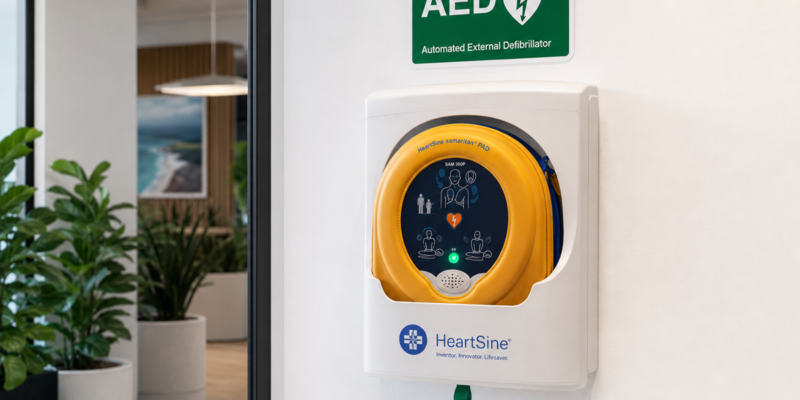
HeartSine is a range of AEDs manufactured to address the core challenge of cardiac resuscitation: delivering a defibrillating shock quickly and accurately, even when the person using the device has no medical training. The devices are designed with simplicity as a priority, and clear audio and visual instructions guide users through every step of the process, from electrode pad placement to shock delivery.
The HeartSine range includes several models suited to different environments and use cases. What unites them is a commitment to the four links in the chain of survival: early recognition, early CPR, early defibrillation, and post-resuscitation care.
What makes HeartSine stand out from other AEDs?
Real-time CPR feedback
One of the most significant differentiators is the live CPR feedback feature available on advanced HeartSine models. This technology monitors chest compression quality in real time and provides audio prompts if the user’s technique needs adjustment, whether that’s push depth, compression rate, or ensuring full chest recoil between compressions.
This matters because good CPR and good defibrillation work together. A shock alone is not enough if blood flow has been inadequate in the minutes prior. HeartSine’s CPR feedback technology addresses this by turning an untrained bystander into a more effective responder.
Compact, lightweight design
The HeartSine Samaritan PAD series is among the lightest AEDs on the market. This has practical benefits: devices are more likely to be mounted in accessible locations, easier to carry to an emergency, and less intimidating for first-time users under stress. The compact form factor doesn’t compromise capability it simply makes it easier to act quickly.
Pad-Pak technology
HeartSine devices use an integrated Pad-Pak system that combines the electrode pads and battery into a single, replaceable cartridge. This simplifies maintenance significantly, as you replace one component rather than tracking pads and batteries separately, and the device is ready to go after a single swap. It also reduces the risk of a device being inadvertently left in an unready state due to partial maintenance.
For organisations evaluating their options, exploring HeartSine defibrillators and their full product specifications is a valuable first step in making an informed decision.
Who should have a HeartSine AED?
The short answer: anyone responsible for a space where people gather. Workplaces with more than 20 employees are increasingly expected to have an AED on-site, and some industries, particularly those with high physical exertion or where workers may be older, carry an elevated risk.
Schools, aged care facilities, fitness centres, sporting clubs, shopping centres, and hotels are all settings where an AED significantly improves survival odds during a cardiac emergency. The HeartSine’s user-friendly design makes it suitable wherever the device may be operated by someone without formal medical training.
Importantly, no AED removes the need for first aid training. A trained responder who understands when and how to use the device — and who can maintain effective CPR while the device analyses rhythm will always achieve better outcomes than an untrained one.
Australian compliance and regulatory considerations
Safe Work Australia guidelines encourage workplaces to assess their first aid needs based on the nature of work, the number of workers, and the distance to emergency medical services. In remote or regional locations, the case for an on-site AED is even stronger.
HeartSine devices are Therapeutic Goods Administration (TGA) listed in Australia, meaning they have been assessed for safety and quality by the relevant regulatory body. When purchasing an AED, always confirm TGA listing to ensure you’re buying a device that meets Australian standards.
It’s also worth considering servicing and warranty arrangements. AEDs should be maintained according to manufacturer specifications, and staff should be trained to recognise when a device needs attention, typically indicated by a visible status indicator on the device itself.
Setting up your AED for success
Purchasing a HeartSine defibrillator is step one. The steps that follow determine whether it will actually be effective in an emergency.
Location is critical. The device should be mounted in a clearly visible, publicly accessible location with appropriate signage. Many facilities choose to position their AED near the main entry point or in a high-traffic area. Avoid locations that require a key or access code to reach; every second of delay reduces survival odds.
Register your device with the national defibrillator network (GoodSAM or similar programs operating in your state) so that trained responders can be alerted to its location during an emergency. Many AEDs in Australia are registered this way, which significantly improves community response outcomes.
Finally, build AED awareness into your workplace induction and first aid training. Staff should know the device is there, where it is, and at a basic level, how it works. This isn’t about turning everyone into a paramedic, it’s about ensuring that in a moment of crisis, no one is standing still simply because they don’t know what to do.
Conclusion
Cardiac arrest is one of those emergencies where preparation makes the difference between life and death in the most literal sense. The HeartSine defibrillator offers a combination of reliability, simplicity, and innovation, including real-time CPR feedback that makes it a strong choice for schools, workplaces, and public facilities across Australia.
Choosing the right AED is a meaningful decision, but it’s the starting point, not the endpoint. Pairing a quality device with proper placement, regular maintenance, and trained staff creates a genuine safety system rather than simply a piece of equipment on a wall. That combination is what gives people in cardiac emergencies their best chance of survival.